
Jordan Ballor

About Jordan Ballor

Jordan Ballor (Dr. theol., University of Zurich; Ph.D., Calvin Theological Seminary) is associate director of the Junius Institute for Digital Reformation Research of Calvin Theological Seminary. He also serves as senior research fellow and director of publishing at the Acton Institute for the Study of Religion & Liberty.

The DPLA, PRDL, and Digital Pointer Services

dpla-logoLast week marked the launch of the Digital Public Library of America (DPLA). As Joseph Esposito over at the Scholarly Kitchen notes,

The most impressive aspect of DPLA is that it is not a library at all, but an intelligently constructed catalogue to many libraries, which are contributing their collections. DPLA, in other words, is a “pointer” service, which is, I think, exactly what the world wants. So a search on DPLA fetches documents from all over the place. I was just looking at something from the holdings of the University of Illinois, then I clicked a bit and was taken to Brewster’s Kahle’s Archive.org. Ten minutes on the home page and you can “visit” many libraries. If this is not cool, I don’t know what is.

This idea of a “pointer” service and the need for some kind of curated metasearch option is precisely what drove the creation of the Post-Reformation Digital Library (PRDL). The PRDL and DPLA are in this respect similar, despite differences in scope, size, scale, support, and (perhaps) significance. We might think of them as “pointer” sisters!

Today the DPLA announced a partnership with the David Rumsey Map Collection, which has a truly impressive array of maps in various formats. Be sure to check out Rumsey’s collection of early modern maps. The oldest map I found thus far was a facsimile of a map of America by one Peter Martyr d’Anghiera (1534).

Come to think of it, “pointer” services like PRDL and DPLA are also “maps” of a kind, pointing us toward heretofore hidden treasure troves of digital source material. Given the overlap in purposes between the two, no doubt our PRDL team will have to take note of the “openness” of the DPLA code and partnership setup that Lincoln Mullen highlights in his intro to DPLA.

“European Calvinism: Church Discipline” at EGO

I had the privilege of collaborating with Brad Littlejohn on an article that was recently published at EGO | European History Online, a valuable digital reference project intended to be “a transcultural history of Europe on the Internet.”

As we note in our apparatus, we made extensive use of the Post-Reformation Digital Library in locating source material, and it is appropriate again to highlight here the usefulness of that tool for a variety of efforts of secondary scholarship.

Our piece, “European Calvinism: Church Discipline,” argues:

While most Reformed churches shared a stress on the importance of discipline, its implementation varied considerably from region to region, due to varying political circumstances and theological emphases. Such differences, however, did not rise to the level of confessional disagreements, and traditional dichotomies between ecclesiologies modeled on Zürich and Geneva, or two-mark and three-mark ecclesiologies, are often overstated.

Take some time to explore the other entries that are already available, such as “Wittenberg Influences on the Reformation in Scandinavia,” and “Religious Orders as Transnational Networks of the Catholic Church,” which has a section on the development of the Jesuits and the transitions in orders after the Reformation. The item “The Wittenberg Reformation as a Media Event” has particular relevance for the voluminous production of source material from the early modern period, which now forms the basis for research tools like PRDL.

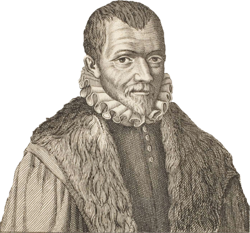
Who Was Franciscus Junius?

Franciscus Junius (1545-1602) © HAB Wolfenbüttel <portrait/a-10770>

The institute’s namesake, Franciscus Junius, is perhaps not well-known outside the community of scholars interested in Reformed theology of the sixteenth and seventeenth centuries. So who was Franciscus Junius?

Junius Institute director Todd Rester provides a brief overview of Junius’ life and work:

François du Jon (1545–1602), Latinized as Franciscus Junius, was a significant Reformed Protestant voice in the era of late sixteenth-century confessionalization. He is perhaps best known as a professor of theology at Leiden University from 1592–1602. Junius was born in Bourges, France, into a family of minor nobility with all of the attendant social and educational advantages of one of such rank. At the age of twelve, Junius matriculated at the academy of Bourges and studied law under the Huguenot jurist, François Douaren (1509–1559) who is recognized as a major voice in articulating the mos gallicus school of applying the fruits of Italian humanism to the legal code of Justinian. Junius also studied under the renowned French humanist, Huguenot, and jurist Hugues Doneau (1527–1591).

As Rester also notes, Junius also would later study under Calvin and Beza in Geneva, and Arminius was named Junius’ successor at Leiden. As Rester puts it, “In 1602 upon his death, it was Junius’ chair of theology (and house on the Rapenburg in Leiden together with most of the furniture) that Jacobus Arminius filled after Junius’ death in the plague that struck Leiden.”

The Post-Reformation Digital Library includes a host of works by Junius in a variety of fields, as well as links to other sources and studies related to this significant representative of early Reformed orthodoxy.

Digital Research Is Not Optional

Quote

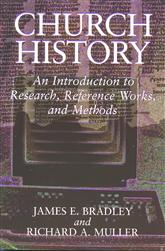
Church History

“We believe that the newer technology, understood broadly, is no longer optional. The scholar who neglects current technological advances in the manipulation and accessing of sources puts himself or herself in the position of the student who refuses to adopt the methodological advances of the Enlightenment; they become, by definition, precritical. The areas in which students can safely ignore the new methods and source mediums are becoming fewer, and even those scholars working in areas as yet untouched by this technology can still benefit from an exposure to the conceptual elegance of unimpeded research, and exhaustive, near-perfect bibliographies.”

–James E. Bradley and Richard A. Muller, Church History: An Introduction to Research, Reference Works, and Methods (Grand Rapids: Eerdmans, 1995), p. 74.

Calvin Theological Seminary launches new digital research center for Reformation studies

Grand Rapids, Mich. (April 22, 2013)—Scholars and students have a new research center devoted to developing digital tools, resources, and scholarship focused on the religious reformations of the early modern era, particularly arising out of the Protestant Reformation of the 16th century. CalvinSemLogoThe Junius Institute for Digital Reformation Research of Calvin Theological Seminary is a natural fit for the seminary community, seminary president Julius Medenblik said. “We’re pleased to see the ongoing efforts of faculty, students, and alumni of the seminary develop into a formal home for projects with exciting possibilities for coming to a better understanding the multi-faceted legacy of the Reformation,” he said.

The institute is conceived as a forum to promote research into the Reformation and post-Reformation periods, covering the 16th to the 18th centuries, through the use of digital tools, skills, and resources. The Junius Institute will house the Post-Reformation Digital Library (PRDL), an electronic database covering thousands of authors and primary source documents on the development of theology and philosophy in these centuries. With the click of a few buttons, researchers can now download digital files with source material from hundreds of years ago. Before recent large-scale digitization efforts, like those undertaken by Google and many European libraries, access to these kinds of sources had been difficult, costly, or even impossible. In some cases sources were simply lost or unknown.
Continue reading