A Whir, Click, and Rustle

Todd Rester, Junius Institute Director

Todd Rester, the director of the Junius Institute, introduces the institute and our new digitization initiative over at the Calvin Seminary website. Click through for the whole thing, but here’s a snippet:

How do you make rare 16th century theological treasures available to students and scholars in the twenty first century? The innovative answer at the Junius Institute for Digital Reformation Research (www.juniusinstitute.org) sounds like the whir of a robot, the click of a camera, and the rustle of 1,500 pages an hour.

The Junius Institute for Digital Reformation Research is a new institute at Calvin Theological Seminary. This institute is dedicated to the preservation and presentation of rare works from the Reformation and post-Reformation era to students and scholars at home and abroad. The hum of these mechanized sounds emanate from an automated book scanner designed by one of the doctoral candidates at Calvin Theological Seminary, Todd Rester, who is also the director of the Junius Institute. “We have an opportunity to present and preserve the rare book holdings of the Hekman Library and the Meeter Center for Calvin Studies in a cost-effective and digital way to make a global impact.”

Todd will be posting more details soon on our proposed plan to digitize a first selection of items from the Hekman Library rare book collection and the holdings of the Meeter Center. But in the meantime, you can also view our digitization project page to see some of the very first works we have digitized.

For more information on the development of the Junius Institute, and ways to support our work, please read this letter from our director.

Google Books Poised to Swell Collection of 18th Century Dutch Theology

It’s no secret that Google has large plans for book digitization. Three years ago the company was reported to have had the ambitious goal of digitizing the 129+ million books thought to be in existence within the coming decade. Although the Chronicle of Higher Education reported in March 2012 that Google was scaling back book digitization at partner institutions in the United States, the same report noted that “[s]ome of its digitization efforts have shifted to Europe.” If Google has shifted its efforts to European libraries, early modern historians have cause to rejoice. Indeed, at least in the case of Koninklijke Bibliotheek (KB; National Library of the Netherlands), which partnered with Google in 2010 to digitize 160,000 public domain books from the eighteenth and nineteenth centuries, book digitization appears to be accelerating.

With most of Google’s partner libraries, it is impossible to know what books are in the process of being digitized. However, the KB catalogue offers a glimpse of books currently tagged for digitization. In order to inform its patrons that a book has been pulled from the shelf, the librarians at KB have added a note: “This book is temporarily unavailable due to digitization.” (“Dit boek is tijdelijk niet beschikbaar vanwege digitalisering.”) A search for this phrase turns up books in the catalogue that either have been recently digitized or will be digitized in the coming months. As of today, there are in the queue over 38,000 titles from the eighteenth century (1700-1799) and 13,000 titles from the nineteenth century (1800-1899).

For users of the Junius Institute’s Post-Reformation Digital Library, this means that in the coming months the collection of available eighteenth-century Dutch theological works is set to rapidly expand. Hundreds, perhaps thousands, of theological works from Dutch Reformed authors will become available in a relatively short period of time. Among these are numerous works by pastors associated with the so-called Nadere Reformatie or “Further Reformation,” including multiple editions of Aegidius Francken’s Kern der Christelyke Leere, which served as a textbook at Calvin Theological Seminary in the nineteenth century. Below is a sampling of links to Reformed theologians with titles set aside to be digitized in the KB catalogue. Taken together, this short list alone represents over 500 digitized titles on the horizon.

Leiden Professors:

Utrecht Professors:

Franeker Professors:

Groningen Professors:

Nadere Reformatie Pastors:

The Junius Institute Digitization Initiative

The Junius Institute is pleased to announce its ability to digitize rare books. There are many far-sighted goals for this local digitization initiative. This initiative advances scholarship and critical study of the sources through the public use of early modern works via high quality digital images. Rare book digitization is a key strategic decision for research institutions, archives, and libraries as they grapple with preservation of rare sources and presentation of the same. Digitization allows both. Digitization also transforms a catalog database from a record to a venue. It is an opportunity to present rare book holdings seamlessly in the local library catalog, increasing access and deepening usability, even allowing institutions the ability to efficiently track usage and interest in rare sources. Thirdly, our ability to digitize rare books is a local initiative with global implications for students and scholars everywhere. Given the rise of tablet and mobile computing in developed and developing countries, the presentation of primary sources in a form that is easily accessible for a wide array of devices can form the basis of global institutional collaboration, expediting the goal of fostering a true exchange of learning. These points are not wishful thinking, we have already received requests and suggestions regarding the Post-Reformation Digital Library from universities, institutions, and academies around the world regarding the particular curricular needs of their students and faculty.

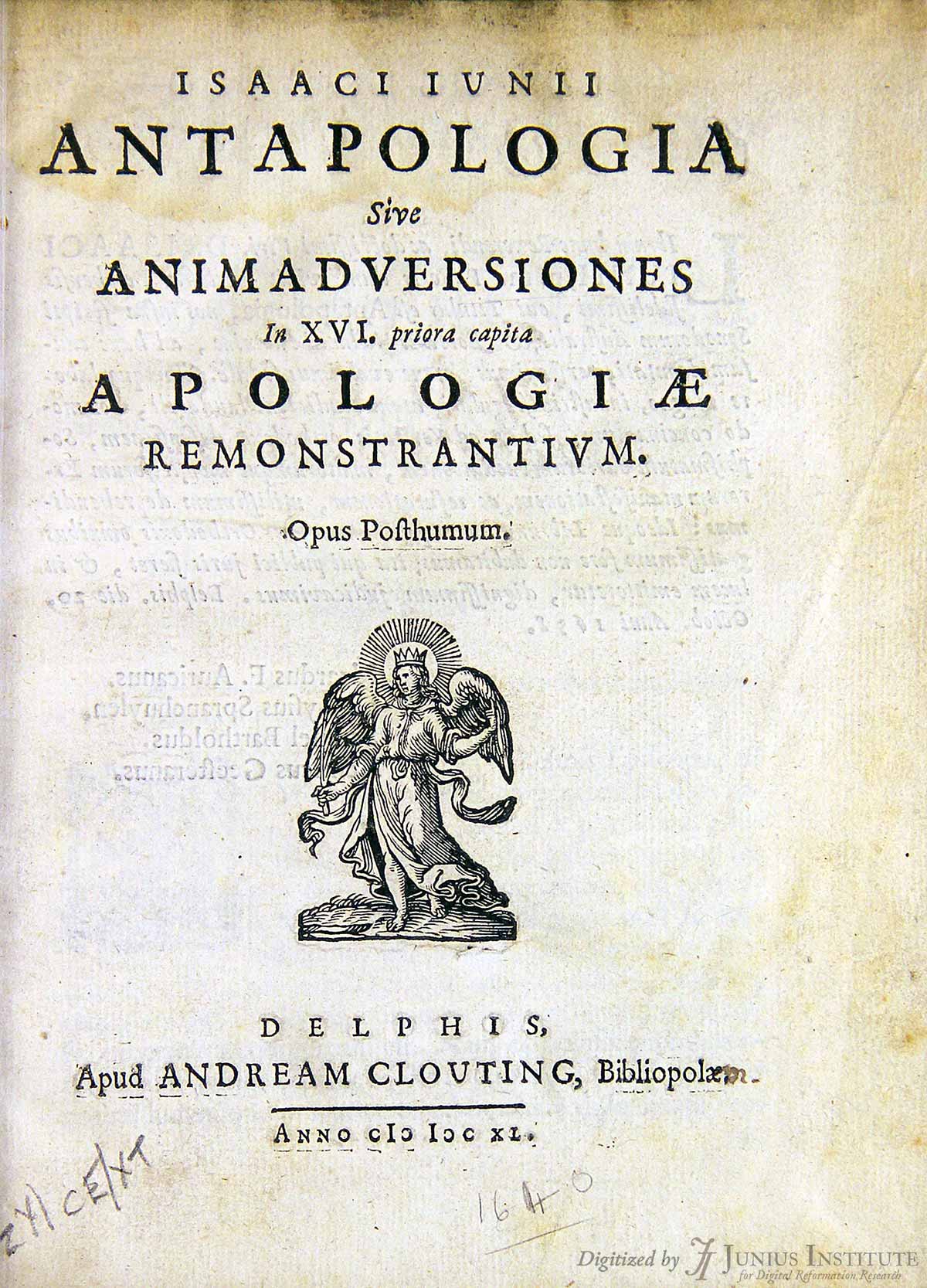
Isaac Junius, Antapologia (1640)

There is also the reality that there are treasures of early modern theology and philosophy tucked away in smaller institutions and private collections. A digitization initiative can be scaled to other institutions, archives, and private collections as a way to build a consortium of truly invaluable sources. One example that we are proud to present is a piece by Isaac Junius simply entitled the Antapologia, or thoughts on the 16 heads of the Remonstrants. Through the generosity of a private owner, we are able to make it available to you. According to Worldcat this piece is housed primarily in Europe and, as far as we are aware, is unavailable in digital form for free. We encourage you to take a moment and browse our version of it here. And yes you may download it in .pdf form.

At the core of the digitization project is an automated digital photography device developed over the past 24 months by an interdisciplinary team I had the privilege of spearheading (several specialists in engineering design, robotics, automation, and computer programming). In particular this device expedites the digitization of rare books while respecting the fragility of their age in a new and innovative way. You can see some of its initial results here. The presentation format is another testimony to David Sytsma’s programming wizardry and is the Junius Institute’s adaptation of a publicly available book viewer. Together we hope we have created a process and result that meets the needs of teachers, scholars, and students in a relatively cost-effective way.

Unprecedented access to primary sources through print media once changed the face of education and shaped all of society in early modern Europe. Now we live in an age where unprecedented access to primary sources through digital media is changing the face of education and all of society in ways only dreamed of a decade ago. We invite you to consider a few things. We are looking for individual and institutional partners who are interested in advancing initiatives of this nature. You might think that is way beyond your means or your contact list, but in my experience scholars and students are a creative and innovative bunch of people. You can be a part of this initiative in a variety of ways: (1) You can sign-up to receive our updates and e-mails. (2) You could fully or partially sponsor the digitization of a particular rare book. (3) You can be the link to put us in contact with individuals or institutions that have a similar vision and desire to advance scholarship through digital means.

We look forward to providing you updates on initiatives of this sort as well as displaying the results in the days ahead.

Maney Journals and EEBO

Maney Publishing is offering a free period of two week access to its journals in philosophy and religion. These include Reformation and Renaissance Review, Political Theology, and Reformation. Details here.

So, if you don’t have regular access, take the time now to go get, for instance, Richard A. Muller’s “Not Scotist: Understandings of being, univocity, and analogy in early-modern Reformed thought” from the latest RRR. [Update: You’ll need to sign up to get access to Maney’s journals first at the “details” link above. Then you should have access to RRR content, including Muller’s article.] It won’t be available during the free period, but I’m also the guest editor for a forthcoming issue of RRR on the legacy of the Italian reformer, Peter Martyr Vermigli. So keep a lookout for that.

Also, the Renaissance Society of America has announced that its members will now have full access to EEBO. So for the price of RSA membership, you can get access to this important primary source collection.

Please Read: A Personal Letter from Todd Rester, Junius Institute Director

Greetings PRDL users and supporters of the Junius Institute,

Just about five years ago, a group of students at Calvin Theological Seminary, with the encouragement and guidance of Dr. Richard Muller, began to collect and share links to primary sources in theology that were increasingly becoming available in digital formats. The original list was limited to sources available on Google Books, and included 331 titles. After proceeding first to a wiki format and later to what is the Post-Reformation Digital Library today, we’ve added more than 4,500 authors and nearly 64,000 titles from digital collections and libraries the world over. There really is nothing else like PRDL out there for early modern theological and philosophical research, and we’re pleased that it has come so far in so short a time.

I’m reminiscing for a couple of reasons. First, I want to thank you for your encouragement, support, and use of the PRDL throughout these years. The whole point of PRDL from the beginning was to make available our individual findings as students and researchers to a broader audience, particularly those that are not blessed with easy access to sources in other venues. Every time you find and download a PDF you found via PRDL that is useful to you in your study, this founding purpose has been fulfilled.

Second, I wanted to let you know that we are at a critical stage in the development and maturation of PRDL. Earlier this year we founded the Junius Institute for Digital Reformation Research at Calvin Theological Seminary to be a formal and permanent home for PRDL as well as other digital research projects. The encouragement from the seminary community has been outstanding, and we’ve been able to develop a variety of projects already this year, including unveiling the Scholastica project, a feature embedded in PRDL that adds a new layer of understanding to the primary sources listed in PRDL.

From the beginning, PRDL and now the Junius Institute have been a labor of love for a group of students, and they will continue to be a passion for us. As many of us have graduated or are graduating, however, the need for financial support to continue focusing on developing digital research tools and methods becomes more significant. For projects like PRDL to be sustainable in the long-term, we need to move toward a model that will fund upkeep, maintenance, development, and improvement.

In the days ahead, we’ll be looking at all of our options for fundraising and development to support the work of the Junius Institute, including PRDL. But as we close out this year, you have a real opportunity to make a difference in the development of digital research on the Reformation era. If you have ever benefited from PRDL or have appreciated the helpfulness of our efforts, please consider making a tax-deductible donation to the Junius Institute at Calvin Seminary. You can make a donation online at Calvin Seminary via this secure form, or you can send a check.

We know that there are many worthy causes that vie for financial support, particularly at this time of year. And yet this truly is an important moment for PRDL and the Junius Institute. Contributions of any size will help show that our efforts mean something to scholars and researchers all over the world.

Even if you aren’t able to make a financial contribution at this time, please consider sharing some thoughts about how the work of the Junius Institute and PRDL has helped you in your work in the comments section below.

Thank you for your support over these years and your continued use of PRDL.
TRsig
Todd Rester
Director
Junius Institute for Digital Reformation Research