Our Informal Anniversary

Our research curator David Sytsma is teaching the doctoral methods course at Calvin Seminary this fall, and he recently passed on that he was discussing the increasing availability of sources that have come to be in the last five years in a recent class session.

He then went digging through some old emails, and found that the original finding list that would grow to become the PRDL, first in wiki and later in the current PRDL 2.0 format, was circulated in October 2008, just over five years ago. You can read more about the transition and development of PRDL in this piece from the Bulletin of the American Society for Information Science and Technology.

David, who directs the PRDL project, writes further, “Looking back through the email thread, it was Jordan who suggested on Nov. 7 that we start a wiki and think about forming a digital research center.” So this day a sort of informal five year anniversary for the beginning of the PRDL and now the Junius Institute!

PRDL now covers over 4,500 authors, with listings of more than 85,000 volumes. Take a look at the original finding list to see where it all began, a short five years ago.

Colloquium: Jay Collier on ‘Troubles after Dort’

Jay T. Collier

Jay T. Collier

One of the things that Dr. Randy Blacketer’s introduction of Richard Muller last week at the CTS PhD anniversary event made clear was the extent to which Dr. Muller has served as a real mentor to so many of his students. One of his legacies in this regard is the fostering of academic development represented in his encouragement of his students to regularly present their research findings in public lectures and readings of papers at conferences.

To this end, a number of years back Dr. Muller helped to create a graduate studies seminar at Calvin Theological Seminary, focused on the historical theology students. This seminar was relatively informal and yet met with some regularity. Current students would often present their research, and graduates would sometimes return to give an update on their current research. Other times visiting scholars would come and give a special lecture to the CTS community.

With the launch of the Junius Institute this year, these gatherings have been formalized into a Colloquium series, pursued in conjunction with the doctoral program at CTS. The aim of the program remains the same: to provide an outlet for students to present research on their dissertations and to be exposed to research projects in progress from graduates and established scholars.

The inaugural Colloquium lecture was given last month (Friday, September 13, 2013) by Jay T. Collier, a PhD candidate in historical theology at Calvin Theological Seminary. Jay also serves as the director of publishing at Reformation Heritage Books and as the project coordinator for the institute’s Colloquium series. After an introduction by Todd Rester, director of the Junius Institute, Jay presented on the topic, “Troubles after Dort: Augustine, Perseverance, and the Real Story of the ‘Arminian’ Richard Montagu.”

As part of our efforts to disseminate scholarship digitally and foster scholarly discourse, we’re happy to make the audio of this event available below. For more on Montagu, visit his page at PRDL. And check out the Colloquium page for more information about upcoming lectures in the Fall 2013 series.

Muller Festschrift Presented at CTS PhD Anniversary Celebration

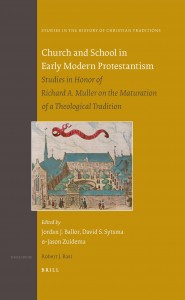
Church and School in Early Modern ProtestantismLast Wednesday Calvin Theological Seminary held a celebration of the 20th anniversary of the school’s doctoral program. Part of the agenda included a lecture by Richard A. Muller, the P.J. Zondervan Professor of Historical Theology at Calvin, who also serves as senior fellow of the Junius Institute. Dr. Muller and Dr. Ronald Feenstra were two of the key faculty appointments at the founding of the doctoral program, and Dr. Muller’s talk focused on the past, present, and possible futures of the doctoral program.

After Dr. Muller’s lecture, Dr. Feenstra introduced an item for the event that did not appear on the schedule: the presentation of a Festschrift to Dr. Muller on the occasion of his 65th birthday this past weekend. I served as a co-editor of the volume along with Dr. David Sytsma, the research curator at the Junius Institute, and Dr. Jason Zuidema. The three of us spoke about the volume and presented a copy to Dr. Muller at the event, who was taken by surprise at the gift and treated to a standing ovation.
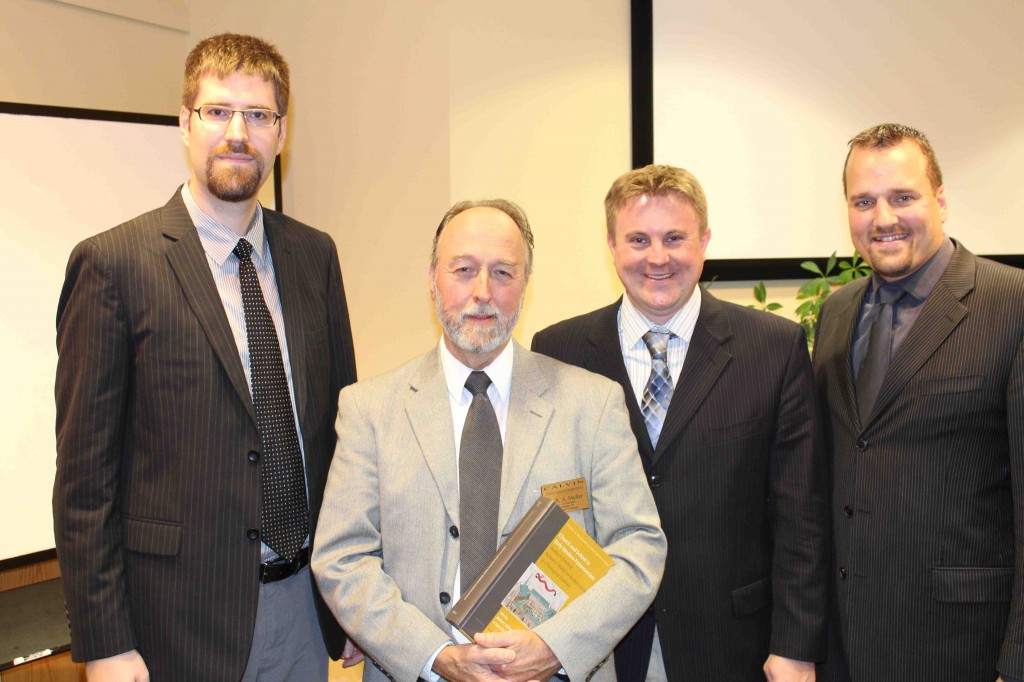
Richard Muller (holding book) stands with the editors of his Festschrift (from left to right): David S. Sytsma, Jordan J. Ballor, and Jason Zuidema

Richard Muller (holding book) stands with the editors of his Festschrift (from left to right): David S. Sytsma, Jordan J. Ballor, and Jason Zuidema

The Festschrift is published by Brill, and appears as no. 170 in the Studies in the History of Christian Traditions series, a series which was founded by Heiko A. Oberman, who was the doctoral supervisor of Dr. Muller’s own supervisor, David Steinmetz of Duke Divinity School. The theme of the volume is captured by the title: Church and School in Early Modern Protestantism: Studies in Honor of Richard A. Muller on the Maturation of a Theological Tradition. As we write in the acknowledgements and dedication:

The scope and scale of Richard Muller’s influence on more than a generation of scholarship of the Reformation and post-Reformation periods is unlikely to be properly appreciated in the near future. But this volume represents an initial attempt toward that end. The size of this collection of essays produced in his honor is merely emblematic of the literature inspired by his helpfully revisionist career. The variety of the essays, both in terms of content as well as in terms of the institutional affiliations of the authors, speaks to the diverse audiences in which Richard’s insights have found positive reception. In attempting to find a unified theme around which to organize this Festschrift, the dynamic relationship between the church and the academy, between the pulpit and the lectern, was chosen, not because it exhausts the implications of Richard’s work, but because it represents one of the key insights of his approach to the sources.

The volume includes work from 55 different contributors, whose variety of institutional affiliation, geographical location, and research interests speaks directly to the significant of Richard Muller’s intellectual legacy. The volume runs in excess of 800 pages, including a 40 page bibliography of Dr. Muller’s work.

You can view photos from the celebration here, and the video of the entire event is available here. A full list of the contributors to the Muller Festschrift in alphabetical order follows, and you can download a table of contents for the volume here:
Continue reading

Colloquium Series Opens This Fall

Zürcher-Disputation 1523The Junius Institute is pleased to announce the launch of its Colloquium program, pursued in collaboration with the doctoral program at Calvin Theological Seminary. The Junius Institute Colloquium formalizes on a more permanent basis a long-standing practice of the historical theology doctoral students of holding occasional public talks on Reformation and post-Reformation history. I’ll be serving as project director, and CTS doctoral candidate Jay Collier will be acting as project coordinator.

A major purpose of the Colloquium is to provide doctoral students “an outlet to present research on their dissertations and to be exposed to research projects in progress from graduates and established scholars.”

The Fall 2013 series opens this Friday with a talk from Jay Collier on the topic, “Troubles after Dort: Augustine, Perseverance, and the Real Story of the ‘Arminian’ Richard Montagu.” Details about time, location, and the rest of the Fall schedule are available at the project page.

Junius Institute Launches PRDL Scholastica

De academia van Vrieslant (Franeker), 1622

Grand Rapids, Mich. (August 30, 2013)—Scholars now have a new tool for the early modern religious and philosophical history in its academic context. From the beginning of the Reformation at the University of Wittenberg to the establishment of the Academy of Geneva, schools were integral to movements of reform as they arose in the sixteenth century and perpetuated themselves into the seventeenth century. PRDL Scholastica, a new project of the Junius Institute for Digital Reformation Research of Calvin Theological Seminary, will facilitate the understanding of this history by allowing the scholar to survey faculties and academic disputations over large stretches of time.

For almost two years, editors of PRDL culled names and dates of appointment for faculty from a variety of sources—online university faculty records, secondary sources on universities, biographical encyclopedias, title pages of primary source disputations, and the personal research of members of the PRDL editorial and advisory boards—resulting in a growing database of over 200 schools and 2,300 faculty appointments.
Continue reading