Ask and It Shall Be Given…

Klaus Graf got the following positive response from Lara Unger, Digital Conversion Supervisor, in reply to his request about moving up items in the digital queue at the University of Michigan:

In fact, we frequently digitize materials for scholars in Europe, particularly music scores. We do have a limit per month per requestor, and how long it takes is dependent on what other projects are being worked on, vacations, etc.

It can take anywhere from a week to 4 or more weeks.

The University has plans to digitize the majority of the materials in its collections. This is why we can agree to not charge for the service, we are going to digitize it anyway, its just a question of when it gets in the queue. A patron request moves an volume up to the front of the line.

I have heard similar anecdotes elsewhere. So when in doubt, it doesn’t hurt to ask.

Google Books, by the by, seems to still have a mechanism for suggesting corrections or rescans for the numerous problems that appear in their books. The older method was convenient, but seems to have been phased out in the new interface. Now, if you try to click on “Help” when viewing a book page (available under the “gear” dropdown menu on the top right when navigating in a book), there is a link under “Help” for “Known Issues – Books,” under which there is another set of menus under “Book quality issues.” If you click on that, you can click on “Book has missing pages, typos, or other kinds of error,” which recommends reporting the error(s) via a form. The form doesn’t seem to work, however.

You can get to this page from other places on Google Books, but it seems to be intended for authors and copyright holders. Also, I recommend using the report error features on Google Books judiciously. Google has been known to pull the entire book out of digital circulation while addressing the reported error. So make sure you’ve gotten whatever copy you need to use in the meantime if it is a source that you want to have access to while any bad scan issues are being addressed.

Two New Mobile Apps of Note

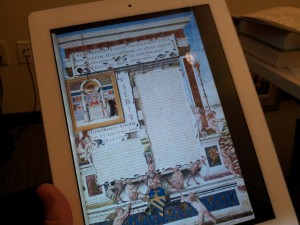
Chronicle of Eusebius of Caesarea (ca. 1480), via e-codices iPad app

Chronicle of Eusebius of Caesarea (ca. 1480), via e-codices iPad app

One of the more intriguing horizons of development in terms of digital research applications is the creation of mobile apps for displaying and manipulating digital texts. The Google Play app, for instance, which allows you to “favorite” Google Books and the Post-Reformation Digital Library have made a helpful pairing for some time.

I recently got notice of two new apps developed for iOS, and ideally experienced on the iPad. The first is the Europeana Open Culture app for the iPad which “introduces you to specially selected collections from Europeana.” Europeana has come a long way, in my view, since it’s opening, and it will be interesting to see how this app makes the vast resources theoretically available at the site actually useful.

The second notice came in today from e-codices, the Virtual Manuscript Library of Switzerland. The e-codices app has been developed for the iPad and iPhone, and will allow you to “search, browse and view medieval and early modern manuscripts in high resolution” on these devices.

My initial experience with these apps has been a bit buggy and inconsistent, but there are some really promising possibilities for display while travelling, giving lectures, presenting papers, and teaching in the classroom. Right now my impression is that the apps might be most helpful for displaying digital texts that you are already aware of rather than really finding new things.

Digital History at SCSC 2013

SCSC2013Prog_Page_01The program for the 2013 meeting of the Sixteenth Century Society Conference in Puerto Rico (October 24-27) has been posted, and it is encouraging to see a variety of panels focusing on digital research methods and topics. Here’s a quick overview:

Friday, October 25, 3:30-5:00pm

114. Early Modern Italy and Pedagogical Practice: From Lay Conservatories to Digital Humanities (Flamingo B)
Organizer: Meredith K. Ray
Chair: Mark Judjevic

  • Educating Rich and Poor Girls in Counter-Reformation Florence
    Jennifer Haraguchi, Brigham Young University
  • Machiavelli and Castiglione: In Service to a Senior Humanities Seminar
    Veena Carlson, Dominican University

120. Digital Maps (1): Mapping the History of Printing and Text Circulation (Tropical A)
Organizer: Colin F. Wilder
Chair: Niall Atkinson

  • “And All the Good Journeymen”: Visualizing the Early Printing Trade
    Greg Prickman, University of Iowa
  • Printing and Text-Transmission Networks in Early Modern Germany
    Colin Wilder, University of South Carolina
  • A cultural Industry on the Digital Highway
    Paul Dijstelberge, University of Amsterdam

Saturday, October 26, 8:30-10:00am

142. Digital Maps (2): Spatial Humanities / New Uses of Digital Mapping (Tropical A)
Organizer: Colin F. Wilder
Chair: Paul Dijstelberge

  • Mapping the Soundscape of Pre-Modern Florence
    Peter Leonard & Niall Atkinson, University of Chicago
  • Envisioning a Historiography: Geospatial and Thematic Connections between Local Social Histories of
    Early Modern Europe
    John Theibault, Richard Stockton College
  • Digital Maps (2): Spatial Humanities / New Uses of Digital Mapping
    Paul Dijstelberge, University of Amsterdam
  • Waves of Empire: Mapping Renaissance Sovereignty at Sea
    Jason Cohen, Berea College

Saturday, October 26, 10:30am-Noon

164. Digital Methods (1): Digitization, Editing and Text Curation (Tropical A)
Organizer: Colin F. Wilder
Chair: John Theibault

  • A comparison of computer-assisted collation techniques
    Gabriel Egan, De Montfort University
  • Standardization and Authenticity: Classroom Use of Archival and Digital Versions of Early Modern
    English Manuscripts
    Marie Baxter, Albion College
  • A Digital Edition of the Business Correspondence of the Venetian printer Giovanni Bartolomeo da
    Gabiano (ca. 1520-1530): Some Technical and Scholarly Considerations
    Giovanni Colavizza, Universitá Ca’Foscari Venezia

Saturday, October 26, 1:30-3:00pm

186. Digital Methods (2): Text Curation, Text Analysis and Network Analysis (Tropical A)
Organizer and Chair: Colin F. Wilder

  • Little Gidding: An Early Modern Digital Humanities Collaboratory
    Whitney Trettien, Duke University
  • Martyrs, Exiles and Dissemblers: The Networking of Protestants during the Marian Persecution (1553-1558)
    Martin Skoeries, University of Leipzig
  • Topic-Modeling the Correspondence of Hugo Grotius
    Matthew Simmermon-Gomes, University of Aberdeen

Saturday, October 26, 3:30-5:00pm
208. Roundtable: Early Modern Digital Humanities (Tropical A)
Organizer and Chair: Colin F. Wilder

Participants:

  • Matthew Simmermon-Gomes, University of Aberdeen
  • Whitney Trettien, Duke University
  • John Theibault, Stockton College
  • Greg Prickman, University of Iowa
  • Paul Dijstelberge, University of Amsterdam
  • Niall Atkinson, University of Chicago

Tropical A certainly looks like the place to be. You can download a PDF of the program here. This will be the first conference I’ve missed in a number of years, and it just happens to be one that is chock-full of sessions related to digital research! This is an encouraging trend, and no doubt one that will continue in the years ahead.

Post-Doctoral Fellowships at the University of Warsaw

Courtesy of our friends at the University of Warsaw’s Committee on the Study of Reformation in Poland and East-Central Europe, including PRDL editorial advisory board member Piotr Wilczek, here is some information about post-doctoral fellowship opportunities in Poland for the research project, “The Traditions of Mediterranean Humanism and the Challenges of Our Times: The Frontiers of Humanity.”

The application deadline is June 23 and proposals related specifically to the Reformation/Reformations are welcomed for the special section of the project, “Universal Reformation: Intellectual Networks in Early Modern Central Europe.”

Prof. Wilczek can be contacted directly for more information about this opportunity.

Save the Date: The 20th Anniversary of the Doctoral Program at CTS

CalvinSemLogoGiven the connections between the Junius Institute and Calvin Theological Seminary, and in particular the relationship between the doctoral program in historical theology at the seminary and the work of the institute, it seems appropriate to note the following “save the date”:

20th Anniversary Celebration of the Ph.D. Program

Save Wednesday, October 9, 2013 for the 20th Anniversary Celebration of Calvin Theological Seminary’s Ph.D. Program. There will be a special lecture by Dr. Richard A. Muller from 3:00 – 4:30 p.m. in the Auditorium, and a reception in the atrium from 4:30 – 6:00 p.m. Watch for an official invitation in August 2013.

Dr. Muller is the P.J. Zondervan Professor of Historical Theology at the seminary and a senior fellow with the Junius Institute. Among his many contributions to scholarship and the church, Dr. Muller gave a noteworthy inaugural address at CTS in 1995, “Scholasticism and Orthodoxy in the Reformed Tradition: An Attempt at Definition.”

More details about the program will be posted as they become available.