Defending Dissertations at CTS

I had the privilege yesterday of attending the successful defenses of two Ph.D. candidates at Calvin Theological Seminary under the supervision of Dr. Richard Muller, senior fellow of the Junius Institute and PJ Zondervan professor of historical theology at CTS. These two projects are fine examples of the importance of dissertation research for a variety of reasons, including those highlighted previously by David Sytsma. A number of dissertations from the CTS program are available here.

The first dissertation defense yesterday was by Ted Van Raalte, a contributing editor at the Post-Reformation Digital Library and newly-appointed professor of ecclesiology at the Canadian Reformed Theological Seminary.

In a dissertation titled, “Antoine De Chandieu (1534-1591): L’un des pères de la scholastique réformée?” Van Raalte explored a number of sources, including Chandieu’s Locus de Verbo Dei Scripto, adversus humanas traditiones, theologice et scholastice tractatus (Bern: Le Preux, 1580). Visit Chandieu’s page on PRDL for other easily accessible digital sources by this significant French reformed figure.
TVR

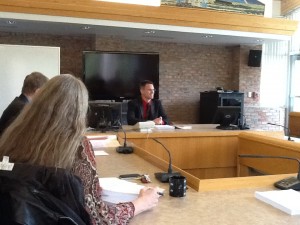
Ted Van Raalte defends his dissertation (Calvin Theological Seminary)

Continue reading

Virtual Paul’s Cross Project

One of the aspects of the digital age that is especially exciting is the ability to interact not only with source texts but to recreate early modern contexts.

The Virtual Paul’s Cross Project is particularly fascinating. The project is conceived as “a digital re-creation of John Donne’s Gunpowder Day Sermon” at Saint Paul’s Cross in 1622. The project is multi-sensory, including a 3D digital model as well as an acoustic model and the full sermon from a variety of perspectives.

Here’s an HD fly-around of the visual model:

Check out too the process of developing the sermon script itself and the text history.

Take some time to explore the project! There’s also a nice overview provided over at Early Modern Online Bibliography.

The Mutilation of De Monetae Mutatione

JuanDeMarianaSome years ago I was working on the publication of a short translation of the Jesuit scholar Juan de Mariana’s De monetae mutatione. Back when the original translation had been commissioned, one of the only readily available domestic copy of this seventeenth-century treatise was held at the Boston public library. The translator, Fr. Patrick T. Brannan, worked off of that manuscript in producing the translation.

As I worked on editing the text for further publication, I needed to consult the original to clear up a few editorial queries. But I did not have a copy of the treatise by Mariana easily at hand to do some comparison. So naturally I went over to the Post-Reformation Digital Library to see if the original was listed among the site’s contents.

I was not disappointed. There were in fact multiple copies of the collection of treatises which included De monetae. Mariana’s treatise, De monetae mutatione, was the fourth of seven treatises published together in 1609 in Cologne. Via the PRDL I quickly downloaded a version.
Continue reading

One Step Ahead of the Inquisition

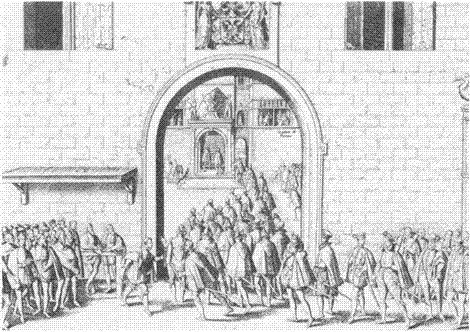
Noblemen presenting their petition to the Duchess of Parma (April 1566). Source: DBNL: digitale bibliotheek voor de Nederlandse letteren

We have all seen movies or read novels where the hero or villain is just one step ahead of the authorities. At barely 20 years old, Junius became a minister to a Reformed conventicle in Antwerp. According to his own journal entries in November and December 1565, after presiding over a clandestine Reformed service among many leading Dutch nobility (Nov. 2), Junius was present for a key conversation involving a conspiracy to take Antwerp by military force by December 3, a plot only dissuaded by Orange himself in favor of more diplomatic means to secure toleration and prevent the arrival of the extraordinary inquisition (ordinary being local by the bishops, extraordinary commissioned by the pope). The confederacy of nobles eventually produced a compromise petition that was presented to the Duchess Margaret of Parma in April 1566.

The petition was signed by approximately 400 noblemen throughout the Netherlands–correction 400 noblemen that could raise, by some estimates, 15,000 heavily armed troops. This brief excerpt from Gerard Brandt’s The History of the Reformation in the Low Countries (1720), details how Junius barely escaped arrest in early 1566 for writing a letter to the King of Spain regarding religious conscience. Once it was discovered that the author was a French Reformed pastor operating clandestinely and illegally in Antwerp, the Marquis of Antwerp enlisted the aid of an artist/spy. The spy would infiltrate Junius’ conventicle, gain his trust, and eventually return a sketch of Junius’ likeness that he might be arrested and his quarters searched. The artist even tailed Junius back to his lodgings. You can read the excerpt to find out how this caper ended.

What a good reminder to historians and theologians how much cloak and dagger surrounded issues of freedom of conscience and toleration in the 16th century, even for a 20 year-old pastor.

The DPLA, PRDL, and Digital Pointer Services

dpla-logoLast week marked the launch of the Digital Public Library of America (DPLA). As Joseph Esposito over at the Scholarly Kitchen notes,

The most impressive aspect of DPLA is that it is not a library at all, but an intelligently constructed catalogue to many libraries, which are contributing their collections. DPLA, in other words, is a “pointer” service, which is, I think, exactly what the world wants. So a search on DPLA fetches documents from all over the place. I was just looking at something from the holdings of the University of Illinois, then I clicked a bit and was taken to Brewster’s Kahle’s Archive.org. Ten minutes on the home page and you can “visit” many libraries. If this is not cool, I don’t know what is.

This idea of a “pointer” service and the need for some kind of curated metasearch option is precisely what drove the creation of the Post-Reformation Digital Library (PRDL). The PRDL and DPLA are in this respect similar, despite differences in scope, size, scale, support, and (perhaps) significance. We might think of them as “pointer” sisters!

Today the DPLA announced a partnership with the David Rumsey Map Collection, which has a truly impressive array of maps in various formats. Be sure to check out Rumsey’s collection of early modern maps. The oldest map I found thus far was a facsimile of a map of America by one Peter Martyr d’Anghiera (1534).

Come to think of it, “pointer” services like PRDL and DPLA are also “maps” of a kind, pointing us toward heretofore hidden treasure troves of digital source material. Given the overlap in purposes between the two, no doubt our PRDL team will have to take note of the “openness” of the DPLA code and partnership setup that Lincoln Mullen highlights in his intro to DPLA.